OINP迎来重大改革:国际学生时代结束了吗?
Read in English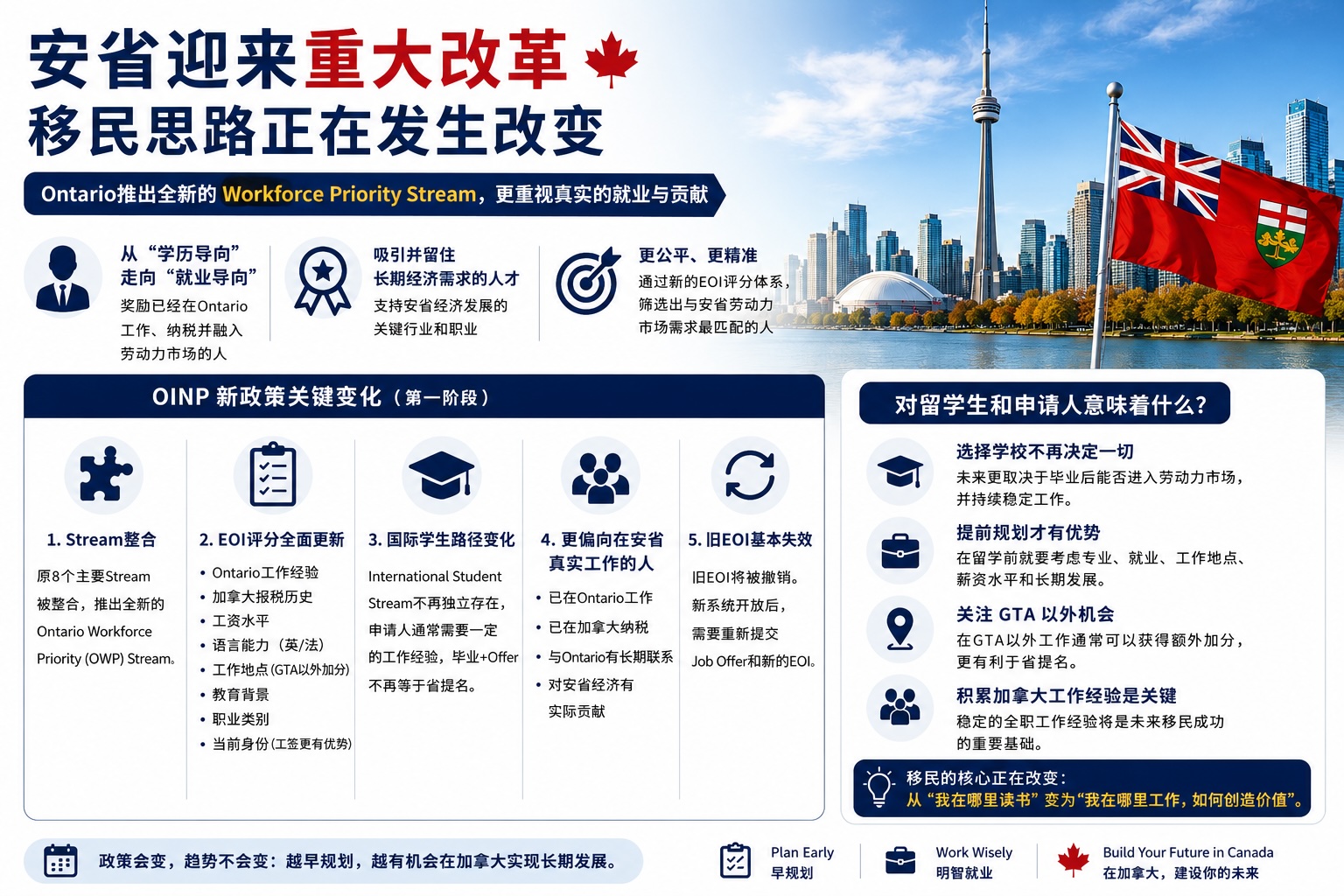
Ontario推出全新的Workforce Priority Stream, 这不仅是一次项目调整, 更反映出安省移民政策方向的一次重大转变。
2026年7月, Ontario Immigrant Nominee Program(OINP) 正式启动第一阶段改革, 推出全新的Ontario Workforce Priority(OWP)Stream, 并同步启用全新的Expression of Interest(EOI)评分体系。
很多人关注的是哪些项目被取消、哪些项目被整合, 但真正值得关注的,并不是项目名称, 而是安省究竟希望吸引什么样的申请人。
这次改革到底改变了什么?
根据新政策, Ontario将多个原有省提名类别 整合至新的Workforce Priority Stream, 并重新设计EOI评分体系。
新的评分标准更加重视申请人与安省劳动力市场之间的联系,例如:
- 安省工作经验;
- 加拿大报税记录;
- 工资水平;
- 英语或法语能力;
- 工作地点,尤其鼓励GTA以外地区;
- 职业类别;
- 当前就业情况。
相比之下, 过去广受国际学生关注的 Employer Job Offer – International Student Stream 已不再作为独立类别存在, 而是纳入新的Workforce Priority框架。
这意味着, 安省正在重新定义什么样的申请人更具竞争力。
真正改变的,不是项目,而是移民理念
过去,Ontario省提名一直给予加拿大教育经历较高的认可。
对于许多国际学生来说, 完成学业、获得符合要求的工作机会, 往往是一条相对成熟的移民路径。
而新的评分体系则释放出更加明确的信号: 安省越来越重视申请人已经为本省劳动力市场创造了多少价值, 而不仅仅是是否拥有加拿大学历。
学历仍然重要, 但已经不再是决定竞争力的核心因素。
真正受到重视的是:
- 是否已经进入安省劳动力市场;
- 是否拥有稳定工作;
- 是否具有持续就业能力;
- 是否已经开始为加拿大经济作出贡献。
可以说,Ontario正在逐渐从“学历导向” 转向“就业导向”。
谁将受到最大的影响?
新的EOI体系下, 不同申请人的竞争格局正在发生变化。
相对而言,以下申请人可能更具优势:
- 已经在安省稳定工作的申请人;
- 拥有加拿大工作经验及报税记录的人士;
- 工资水平较高的申请人;
- 从事紧缺职业或重点行业的人士。
另一方面, 一些过去具有明显优势的群体, 则可能面临更加激烈的竞争。
例如,国际学生虽然仍然可以申请安省省提名, 但过去加拿大教育经历所带来的相对优势正在减弱。
对于刚毕业、尚未建立稳定工作经验和就业记录的申请人而言, 新制度可能意味着需要面对更加直接的竞争。
这并不意味着国际学生失去了移民机会, 而是意味着竞争重点已经发生改变。
Ontario并不是唯一这样做的省份
事实上,这并不是Ontario单独采取的措施。
过去两年, 加拿大多个省份陆续调整了自己的移民政策:
- BC更加重视符合经济需求的职业;
- Alberta持续根据劳动力市场需求调整邀请方向;
- Manitoba不断提高本省工作经验的重要性;
- 如今,Ontario也开始更加重视申请人与本省经济之间的联系。
与此同时, 联邦Express Entry也逐步推出职业类别邀请 (Category-based Selection), 进一步强化了职业需求导向。
这些政策虽然形式不同, 却反映出相同的发展方向: 加拿大各级移民项目正在逐渐从“教育导向” 转向“就业导向”, 越来越重视申请人对加拿大劳动力市场的实际贡献。
我们的观察
近年来,我越来越发现, 加拿大移民政策关注的重点正在发生变化。
过去,一个加拿大学历本身往往就是竞争优势。
如今,政策更加关注的是申请人 是否已经成功进入劳动力市场, 并能够长期满足加拿大经济发展的需要。
对于国际学生而言, 这意味着加拿大学历仍然具有价值, 但学历本身已经不足以形成过去那样明显的竞争优势。
对于所有申请人而言, 无论是国际学生,还是海外技术工人, 未来真正决定竞争力的, 将越来越不是身份, 而是就业能力, 以及能否持续为加拿大经济和劳动力市场作出贡献。
从永久居民配额的重新分配, 到国际学生人数下降, 再到Ontario省提名改革, 加拿大移民政策正在传递同一个信号: 未来的移民制度, 将越来越围绕劳动力市场需求 和长期经济贡献进行设计。
本文仅供一般信息参考, 不构成法律意见或移民建议。 具体申请应结合个人情况进行专业评估。
Ontario’s Immigration Reform: Are International Students Losing Their Competitive Edge?
Ontario’s introduction of the new Workforce Priority (OWP) Stream is more than a program restructuring—it reflects a significant shift in the province’s immigration priorities.
In July 2026, the Ontario Immigrant Nominee Program (OINP) officially launched the first phase of its redesign by introducing the Ontario Workforce Priority (OWP) Stream together with a new Expression of Interest (EOI) scoring system.
While much of the discussion has focused on which streams were merged or renamed, the more important question is this: What kind of immigrants is Ontario now trying to attract?
What Has Changed?
Under the new framework, existing provincial nomination streams have been consolidated into the new Workforce Priority Stream, accompanied by a redesigned EOI system.
The new selection criteria place greater emphasis on an applicant’s connection to Ontario’s labour market, including:
- Ontario work experience;
- Canadian tax history;
- wage level;
- English and/or French language proficiency;
- employment location, particularly outside the Greater Toronto Area;
- occupation; and
- current employment status.
One of the most notable changes is that the former Employer Job Offer – International Student Stream is no longer a standalone pathway and has been incorporated into the new Workforce Priority framework.
This represents more than an administrative restructuring—it signals a shift in how Ontario evaluates competitiveness.
A Change in Immigration Philosophy
For many years, Canadian education has been one of the strongest advantages within Ontario’s provincial nomination system.
For international students, graduating from an Ontario institution and securing a qualifying job often provided a well-established pathway toward permanent residence.
The new scoring system suggests that Ontario is placing increasing value on demonstrated participation in the provincial labour market, rather than educational credentials alone.
Education remains important, but it is no longer the primary factor that determines competitiveness.
Instead, Ontario appears to be rewarding applicants who have already demonstrated their ability to contribute to the province through:
- meaningful employment;
- stable labour market participation;
- continued economic contribution; and
- long-term integration into Ontario’s workforce.
In other words, Ontario is gradually shifting from an education-driven model to a more employment-driven approach.
Who Is Most Affected?
The redesigned EOI system changes the competitive landscape for different groups of applicants.
Applicants who may benefit from the new approach include those who:
- have already established themselves in Ontario’s labour market;
- possess Canadian work experience and tax history;
- earn competitive wages; and
- work in occupations that address labour market needs.
At the same time, some applicants who previously enjoyed a comparative advantage may now face greater competition.
International students remain eligible to pursue provincial nomination, but the advantage historically associated with obtaining a Canadian education appears to have become less significant.
For recent graduates who have not yet accumulated meaningful Canadian work experience or established a stable employment record, competition is likely to become more challenging.
This does not mean that pathways for international students have disappeared.
Rather, it suggests that the basis of competition has changed.
Ontario Is Not Alone
Ontario’s reform is part of a broader trend across Canada’s immigration system.
Over the past two years:
- British Columbia has increasingly prioritized occupations that meet labour market demands;
- Alberta has continued to target applicants based on economic needs;
- Manitoba has placed greater emphasis on in-province employment; and
- Ontario is now moving in a similar direction by rewarding stronger labour market attachment.
At the federal level, Express Entry has also evolved through the introduction of category-based selection, placing greater emphasis on occupations that support Canada’s economic priorities.
Although each province has adopted its own approach, they are all pointing toward the same policy direction: Canada’s immigration system is gradually shifting away from rewarding educational credentials alone and toward selecting applicants who can demonstrate meaningful, long-term contributions to the labour market.
Our Perspective
Over the past few years, one trend has become increasingly clear.
Canadian immigration policy is no longer focused primarily on who an applicant is, but rather on what an applicant contributes.
A Canadian education continues to hold value, but it no longer carries the same competitive advantage it once did within provincial nomination programs.
For international students, this represents a significant policy shift.
For all applicants, whether international graduates or experienced foreign workers, the defining factor is becoming less about immigration category and more about employability, economic contribution, and long-term participation in Canada’s workforce.
From the reallocation of permanent resident admissions to the decline in international student approvals, and now Ontario’s provincial nomination reform, a consistent message is emerging: Canada’s immigration system is increasingly being designed around labour market needs and long-term economic contribution, rather than education alone.
This article is intended for general informational purposes only and does not constitute legal or immigration advice. Immigration policies continue to evolve, and applicants should seek professional advice based on their individual circumstances.